







SEA Ferry Yield & FOM Guide
 Le Quoc KhoiCEO, Ferry VN JSC

Key Takeaways: Purpose-built ferry booking software and Ferry VN's Ferry Operation Management (FOM) architecture protect operator profitability in Southeast Asia differently from airline pricing engines or European overnight-cabin platforms. When marine diesel surges against fixed retail tariffs, operators lift margins by maximizing Load Factor, capturing higher-yield international OTA demand, and tightening port-to-ledger controls.
- Verified Fuel-Margin Shock: Public filings from Superdong (HOSE: SKG) showed Q3 2026 revenue up +9% YoY (over VND 107 billion) while net profit dropped 96% to under VND 300 million after diesel (DO) jumped >50%.
- Load Factor Over Price Hikes: Filling midweek and shoulder-season empty seats via international OTAs and structured sub-agent tiers beats aggressive headline fare increases on competitive corridors.
- SEA FOM Capabilities: Purpose-built regional systems unify counter POS, VIMAWA port manifests, offline Ed25519 QR boarding scans, operator-configured Decree 70/2025 type M e-invoices, bank reconciliation, and OAuth 2.0 Agent APIs.
- Multi-Channel Reach: Connecting fleet inventory to Ferry VN's B2B ecosystem opens 150+ agencies, 13,000+ users, and six global and regional OTAs without adding multilingual IT staff.
Choosing ferry booking software for Southeast Asian island fleets requires looking past textbook airline yield models. Coastal operators across Vietnam, Indonesia, and Thailand lack captive frequent-flyer monopolies, and local fare norms paired with fierce multi-carrier corridor rivalry block aggressive ticket price hikes whenever marine diesel costs surge.
Meanwhile, voyage expenses remain heavily fixed: crew payroll, vessel depreciation, port berthing fees, and daily fuel burn accrue identically whether a fast catamaran sails 90% full or 35% full. Below is the 2026 fuel-margin compression evidence, five load-factor yield levers, and exact software benchmarks engineered for Southeast Asian maritime fleets.
Why Fuel Volatility and Fare Caps Break Traditional Ferry Economics
High-speed passenger vessels carry steep fixed-cost intensity because crew, berthing, and depreciation costs dominate every departure while marine diesel (DO) drives sharp variable-cost swings. Once a trip covers break-even seats, extra passengers drop straight to contribution margin — whereas weak weekday Load Factors wipe out quarterly earnings.
Disclosures from Superdong Kien Giang (HOSE: SKG) on the Ho Chi Minh Stock Exchange prove the point clearly. After posting FY2025 revenue of VND 422 billion (+11% YoY) and VND 48 billion net profit (+41% YoY), Superdong's Q3 2026 revenue climbed +9% YoY to over VND 107 billion while net profit sank 96% to under VND 300 million because diesel jumped >50% against flat ticket fares.
| Financial Cost Layer | Behavior per Sailing | Margin Impact During Fuel Shock | Yield & Software Mitigation Lever |
|---|---|---|---|
| Marine Diesel (DO) Fuel | High variable burn per nautical mile | Direct gross-margin shock (>50% jump in Q3 2026) | Consolidate low-load sailings and maximize off-peak load factor |
| Crew, Maintenance & Depreciation | Fixed regardless of passenger load | Raises break-even seat count in shoulder months | Capture midweek inbound OTA bookings without fare cuts |
| Port Fees & Compliance | Per-departure & per-pax statutory charges | Magnifies clerical errors under manual manifests | Automate VIMAWA manifests and Decree 70/2025 type M e-invoices |
| Agency Credit & Ledgers | Scales linearly with agency count | Triggers cash leaks and unauthorized discounting | Replace Zalo/Excel books with automated F1–F4 wallet controls |
Review macro sector figures and full fleet counts in our Vietnam ferry market report 2026 and Vietnam ferry operators directory.
Five Load-Factor Yield Levers for Southeast Asian Ferry Operators
When corridor competition blocks retail fare increases, fleet executives turn to capacity, channel, and leakage management across five operational levers:
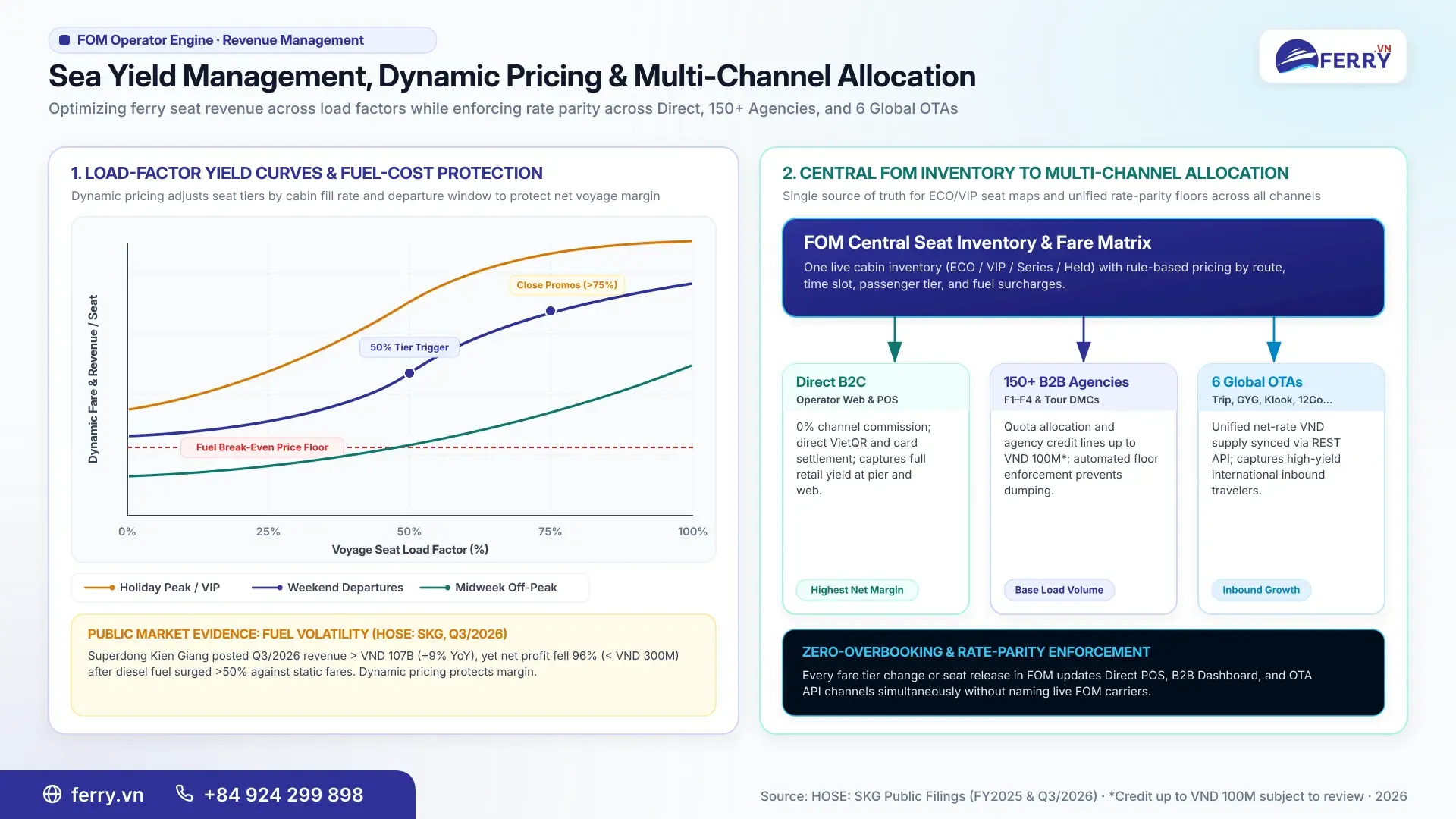
- Fill Midweek Troughs With Inbound OTA Demand: Domestic traffic peaks sharply on weekends, leaving Tuesday–Thursday sailings underutilized. International travelers (whose Phu Quoc arrivals surged 60.2% YoY to >1.92 million in 9M 2026, air and sea combined) book weekdays weeks ahead. Exposing unused seats on Trip.com, GetYourGuide, 12Go, Klook, Viator, and Tatinta lifts load factor without discounting port counters.
- Merchandise VIP vs. ECO Cabins Visually: On high-capacity vessels (such as 223–598 seat catamarans), displaying interactive VIP seat maps across OTAs captures international willingness to pay for upper-deck comfort without raising base ECO fares.
- Enforce Multi-Tier Price Parity (F1–F4): Ad-hoc Zalo discounting erodes published tariffs and sparks conflict between master agencies and sub-agents. Moving agencies onto Ferry VN's B2B distribution ecosystem via API partner onboarding enforces structured tier markups and prepaid wallets.
- Stop Pier-Gate Leakage With Cryptographic QR: Paper stubs miss uncollected manifests or duplicate entries. Handheld QR verification ties boarded counts directly to paid ledger records.
- Automate Monsoon Disruption Handling: During September–February Beaufort Force 6 closures, automated cancellation broadcasts and statement matching protect staff EBITDA across peak storm windows.
Compare commercial settlement across global channels in our OTA fare models.
Ferry Booking Software Benchmarks: EU/US Legacy vs. Southeast Asia FOM
European maritime systems built for Baltic car decks lack Vietnamese tax connectors and multi-tier agency ledgers, while repurposed intercity bus platforms lack VIMAWA manifests, Force 6 disruption workflows, and offline pier scanning. Ferry VN's Ferry Operation Management (FOM) suite addresses Southeast Asian coastal fleet operations natively.
Core Modules: Port POS, Offline QR, and VIMAWA Manifests
FOM unifies port Point-of-Sale (POS) desks, direct websites, domestic agencies, and international OTAs on one real-time seat pool. Under Decree 33/2025/ND-CP (creating VIMAWA) and Circulars 16/2013 and 10/2024 published on the Vietnam Government Portal, operators compile verified passenger manifests (including statutory forms) before port departure clearance.
Because coastal piers face unstable 4G coverage during boarding rushes, FOM signs QR e-tickets using Ed25519 cryptography, letting handheld scanners validate boarding offline via IndexedDB and sync boarded counts cleanly once mobile data returns.
Financial Controls: Decree 70/2025 E-Invoices, Reconciliation, and Agent APIs
Effective June 1, 2025, Decree 70/2025/ND-CP mandates cash-register e-invoices (type M) listing vessel registration and route, replacing cancellations with adjustment or replacement e-invoices. FOM operators configure their own tax connectors (such as MISA meInvoice type M) and payment gateways under their own legal entity — kept strictly separate from B2B SaaS fees — while automated bank-statement reconciliation and OAuth 2.0 Agent APIs eliminate manual ledger matching.
| Evaluation Benchmark | EU / North America Legacy Software | Repurposed Domestic Bus BMS | Purpose-Built SEA FOM (Ferry VN FOM) |
|---|---|---|---|
| Vessel & Seat Modeling | Overnight cabins & multi-lane freight | Bus grids lacking vessel/deck hierarchy | ECO/VIP deck maps, multi-stop hops, vessel swaps |
| Pier-Gate Boarding | Expensive fixed terminal gates | Paper lists or online-only QR | Offline Ed25519 QR scanning on standard handhelds |
| Port Manifests | EU SafeSeaNet templates | Absent | Built-in VIMAWA manifest fields & statutory exports |
| Vietnam Tax (NĐ 70/2025) | Unsupported | Partial road transport billing | Operator-configured cash-register e-invoice (type M) |
| Agency Hierarchy | Direct B2C or simple agent login | Basic 1-level broker desk | Native 4-tier F1–F4 tree, credit controls, bank matching |
| Global OTA Reach | EU ferry switches | Zero international OTA APIs | Direct supply to 6 global & regional OTAs |
| Weather Disruption Ops | Manual timetable edits | Phone cancellations | Bulk status 16 broadcasts & refund ledger isolation |
Review manifest payload standards in our OTA channel manager guide and e-ticket QR code and manifest spec.
Modernizing Fleet Yield and Multi-Channel Distribution
Ferry VN JSC (Tax ID 1801802790) connects 15+ Vietnamese ferry operators to 150+ agencies, 13,000+ users, and six live OTAs as of November 2026 (with automated issuance speeds dependent on each carrier's underlying infrastructure and standard 30–45 minute port check-in closes). Operators protect yield in three steps: audit weekday empty seats and manual reconciliation drag, plug core inventory into Ferry VN's Operators distribution network and unified API layer, and deploy modular FOM controls across POS, offline QR, and VIMAWA manifests.
Explore regional multimodal trajectories in our intermodal travel guide, compare tiers on Ferry VN Pricing, or inspect integration manuals in Ferry VN's operator and API docs (hi@ferry.vn · +84 924 299 898).
FAQ
Frequently Asked Questions
Why is yield management different for Southeast Asian ferries compared to airlines?
Southeast Asian island ferry operators face local fare caps, strong corridor competition, and high fixed voyage costs. Instead of aggressive headline price surges, profitable ferry yield management focuses on lifting off-peak Load Factor via inbound OTAs, optimizing VIP cabin mix, and eliminating agency reconciliation leakage.
What did Superdong's Q3 2026 earnings show about fuel costs and ferry profitability?
Superdong (HOSE: SKG) reported Q3 2026 revenue up 9% year-on-year to over VND 107 billion while net profit dropped 96% to under VND 300 million. A diesel (DO) spike above 50% paired with stable fares proved that margin survival requires higher load factors and automated distribution.
What capabilities distinguish Southeast Asian ferry booking software from European systems?
Purpose-built Southeast Asian FOM software natively supports high-frequency island hops, VIMAWA statutory passenger manifests, offline cryptographic QR boarding scans for unstable port networks, local bank-statement reconciliation, multi-tier F1–F4 agency networks, and operator-configured cash-register e-invoice connectors.
How does Decree 70/2025/ND-CP affect ferry booking software in Vietnam?
Effective June 1, 2025, Decree 70/2025/ND-CP requires direct passenger transport operators to issue cash-register e-invoices (type M) listing vessel registration numbers and origin–destination routes. On Ferry VN FOM, operators configure their own tax e-invoice connectors separately from SaaS subscription fees.
How can a ferry operator increase off-peak load factor without discounting direct fares?
Operators connect unused weekday and shoulder-season seats to international OTAs (Trip.com, GetYourGuide, 12Go, Klook, Viator, Tatinta) and nationwide B2B travel agencies via a unified distribution layer like Ferry VN, capturing international arrivals who book midweek without eroding direct port-counter prices.
- Ferry VN B2B Platform (MST 1801802790)
- Đăng ký đại lý vé tàu 15+ hãng
- Demo B2B Dashboard & FOM
- Tài liệu tích hợp API · SDK · MCP
- Hotline B2B 24/24: 0924 299 898 · hi@ferry.vn
- Zalo OA đối tác: Ferry VN Official

Related articles

Vietnam Ferry Market 2026
Vietnam tourism statistics 2026 for island ferry markets: Phu Quoc 8.57M, Con Dao 612K, SKG Q3 fuel squeeze, VIMAWA Decree 33, and B2B distribution data.

APEC 2027 & Vietnam Ferry Fleets
Phu Quoc tourism statistics hit 8.57M in 9M 2026 (+60.2% international YoY) ahead of APEC 2027: institutional directory of Vietnam's 15+ ferry and Ro-Ro fleets.

SEA Intermodal Ferry Supply
Intermodal travel across Southeast Asia island ferries: why air-to-sea and bus-to-sea OTA trips break at piers and how regional APIs and MCP unify supply.