







SEA Intermodal Ferry Supply
 Le Quoc KhoiCEO, Ferry VN JSC

Key Takeaways: Scaling intermodal travel across Southeast Asia's coastal islands represents the final undigitized frontier for global Online Travel Agencies (OTAs). Because regional fleets across Vietnam, Indonesia, and Thailand do not run European maritime switches, OTAs and AI travel assistants stitch air-to-sea and bus-to-sea journeys by integrating country-level B2B maritime layers such as Ferry VN JSC.
- The Pier-Level Intermodal Wall: Flights, hotels, and rail run on global APIs, yet multimodal trips into Southeast Asian islands break at the port due to fragmented fleets, statutory manifests, and monsoon closures.
- Structural Divergence From Europe: European switches (FerryGateway, LIKNOSS) operate on unified carrier messaging, whereas Southeast Asian corridors divide across private regional fleets settling in local currencies.
- Vietnam's Empirical Proof Point: Ferry VN unifies 15+ Vietnamese ferry operators across an 86-route REST API,
@ferryvn/sdk, and zero-costuatexpressUAT testing (https://api.ferryvn.net).- Safe AI & Intermodal Convergence: Read-only-default
@ferryvn/mcpservers allow AI trip planners to combine flights, coaches, and ferries while isolating ticket issuance and payments inside partner backends.
Across global mobility, intermodal travel connecting airports and intercity buses to Southeast Asia's coastal islands sits at a sharp inflection point. International travelers reserve flights into Ho Chi Minh City, Da Nang, Denpasar, or Bangkok via mature airline Global Distribution Systems (GDSs) and book domestic rail online — only to hit a digital dead end when their route reaches a coastal pier.
As island arrivals climb and travelers expect connected door-to-island checkouts, understanding why maritime legs fail in multimodal carts — and how federated country APIs solve them — defines APAC travel distribution from 2026 through 2030.
Why Island Ferries Remain Southeast Asia's Last Undigitized Travel Leg
Aviation, lodging, and European short-sea lines digitized early because carrier consolidation and open standards like FerryGateway and LIKNOSS (>11 million European tickets annually) enabled one-to-many switching.
Southeast Asia's archipelagic supply evolved differently. Across Vietnam, Indonesia, and Thailand, dozens of independent private fleets run incompatible proprietary reservation software, local bank settlement, and national port-clearance statutes. No European switch maintains direct Vietnamese domestic island inventory, leaving Con Dao, Phu Quy, and Ly Son absent from global rail/bus GDSs.
| Maritime Market | Open Standard Adoption | Carrier Fragmentation | Statutory Manifest & Tax Friction | Global GDS Coverage | Dominant Distribution Bottleneck |
|---|---|---|---|---|---|
| Europe Short-Sea (UK, Greece, Nordics) | High (FerryGateway, LIKNOSS) | Moderate (large national & regional lines) | Harmonized EU maritime reporting | Mature (Direct Ferries, Ferryhopper, LIKNOSS) | Yield optimization & green-fuel rules |
| Vietnam Coastal & Mekong | Zero native FerryGateway adoption | High (15+ independent fast & Ro-Ro fleets) | VIMAWA manifests, Decree 70/2025 e-invoices, Res 202 ports | Absent on LIKNOSS & Distribusion, thin elsewhere | Local adapters, VND deposits, Force 6 bans |
| Indonesia Island Hops (Bali, Gili, Lombok) | Very low | Very high (dozens of fast-boat operators) | Local harbor levies & multi-stop legs | Thin direct API coverage | Multi-stop seats & unstandardized pier ops |
| Thailand Gulf & Andaman | Low (mixed operator systems) | High (seasonal Andaman & Gulf fleets) | Pier transfers & joint bus-ferry combos | Partial via regional retail OTAs | Seasonal activation & bus-to-pier handoffs |
Review our audit of global switches in the global ferry GDS and Vietnam supply-gap analysis and macro figures in our 2026 Vietnam ferry market report.
Four Failure Points Where Multimodal Air-to-Sea and Bus-to-Sea Trips Break
Chaining a flight or overnight coach onto a coastal high-speed ferry fails across four seams that generic transport APIs omit.
Schedule Buffers, Port Cut-Offs, and Async Issuance Mismatches
Airline PNRs confirm synchronously in milliseconds, masking maritime pier cut-offs. Vietnamese ferry ports close check-in 30 to 45 minutes prior to departure for manifest filing, meaning a minor flight delay into Rach Gia, Can Tho, or Ho Chi Minh City misses the final sailing unless transfer buffers are modeled explicitly.
Booking semantics diverge just as sharply. On Vietnam's local carrier systems, booking creation places no upstream hard seat lock on the operator engine, and ticket issuance speed depends on each operator's infrastructure (seconds to 5–8 minutes). Multimodal orchestrators must poll booking state asynchronously and handle partial round-trip issuance explicitly because an issued outbound leg remains valid when a return leg refunds.
Manifest Compliance and Monsoon Disruption Cascades
Under Decree 33/2025/ND-CP (creating VIMAWA under the Ministry of Construction) and Circulars 16/2013 and 10/2024/TT-BGTVT, vessels cannot depart without a verified four-field passenger manifest (full name, birth date, passport/ID, nationality) for every traveler including children and infants.
Monsoon weather creates the sharpest cascade: when northeast winds hit Beaufort Force 6+ (September–February across Con Dao, Phu Quy, and Ly Son), port authorities halt departures across every carrier simultaneously. Without live disruption status feeds (16 Trip Cancelled), signed webhooks, and local bilingual rebooking, one storm strands multimodal travelers across disconnected flights and hotels. Review technical handling in our live availability and disruption sync guide and manifest compliance guide.
Vietnam as the Blueprint: Country-Level Maritime Infrastructure in Action
Vietnam in 2026 demonstrates both the demand catalyst and margin pressure forcing maritime modernization. Verified municipal filings show Phu Quoc passing 8.57 million visitors (air and sea combined) in 9M 2026 (+30.5% YoY, international arrivals up 60.2% to >1.92 million) ahead of APEC 2027, Con Dao passing 612,000 in 2025, and airport-free Phu Quy (~155,000 in 2025) and Ly Son (400,000 target by 2030) relying entirely on sea access.
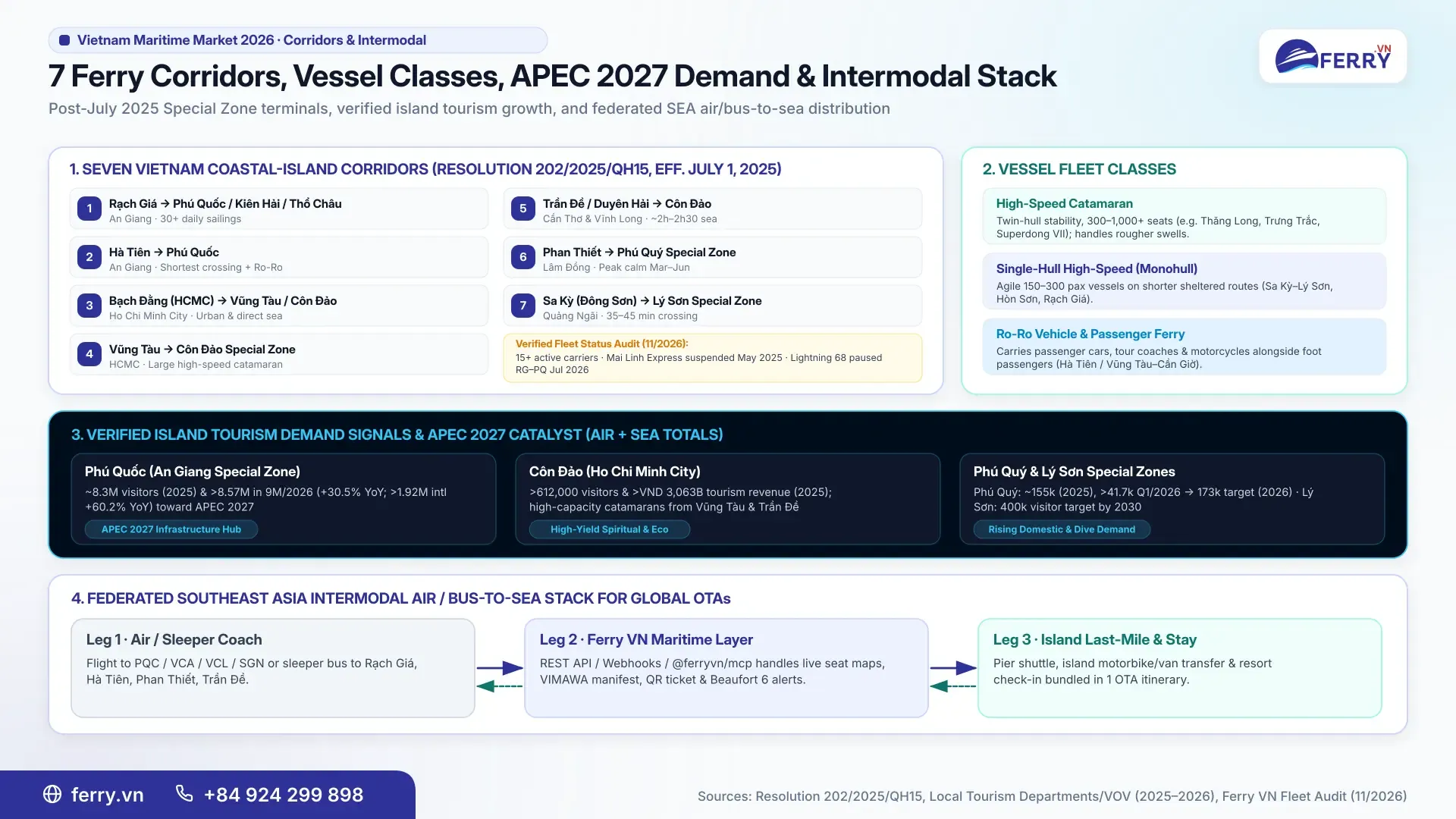
Simultaneously, filings from Superdong (HOSE: SKG) on the Ho Chi Minh Stock Exchange showed Q3 2026 revenue up +9% YoY (over VND 107 billion) while net profit dropped 96% to under VND 300 million as diesel spiked >50% against flat tariffs. Ferry VN JSC (Tax ID 1801802790) serves as Vietnam's pure B2B maritime infrastructure layer — connecting 15+ operators, 150+ agencies, 13,000+ users, and six live OTAs (Trip.com, GetYourGuide, 12Go, Klook, Viator, and Tatinta) as of November 2026 without operating competing retail vessels.
Review fleet capacities and yield tools in our APEC 2027 operators directory and SEA ferry booking software and yield guide.
The Federated Intermodal Stack: Regional APIs, Webhooks, and AI MCP Agents
Waiting for one monolithic global maritime switch to onboard every regional ferry fleet from Ha Tien to Lombok stalls expansion indefinitely. From 2026 to 2030, scalable intermodal travel runs on a Federated Regional Aggregator Stack:
| Distribution Era | Supply Layer | Distribution Interface | Intermodal & AI Readiness |
|---|---|---|---|
| Era 1: Port Counters & Paper | Fragmented fleets on offline ledgers | Walk-in booths, phone/Zalo desks | Zero intermodal visibility and manual storm recovery |
| Era 2: Carrier Web & Manual OTAs | Incompatible proprietary portals | Screen scraping, PDF vouchers, manual ops | Fragile checkout, high overbooking and manifest error rates |
| Era 3: Federated Regional API & MCP | Country-level maritime layers (e.g., Ferry VN) | Unified REST APIs, typed SDKs, signed webhooks, read-only-default MCP | Real-time sea-to-land search, automated disruption feeds, safe AI assembly |
Country-level platforms absorb local carrier adapters, VND banking, VIMAWA rules, and 24/7 bilingual port support. Onboarding through B2B API Partners lets teams integrate 86 /api/v1/ routes via @ferryvn/sdk, verify flows against uatexpress on UAT (https://api.ferryvn.net), and opt into Standard Webhooks HMAC-SHA256 (3 retries) to coordinate downstream flight/coach alerts.
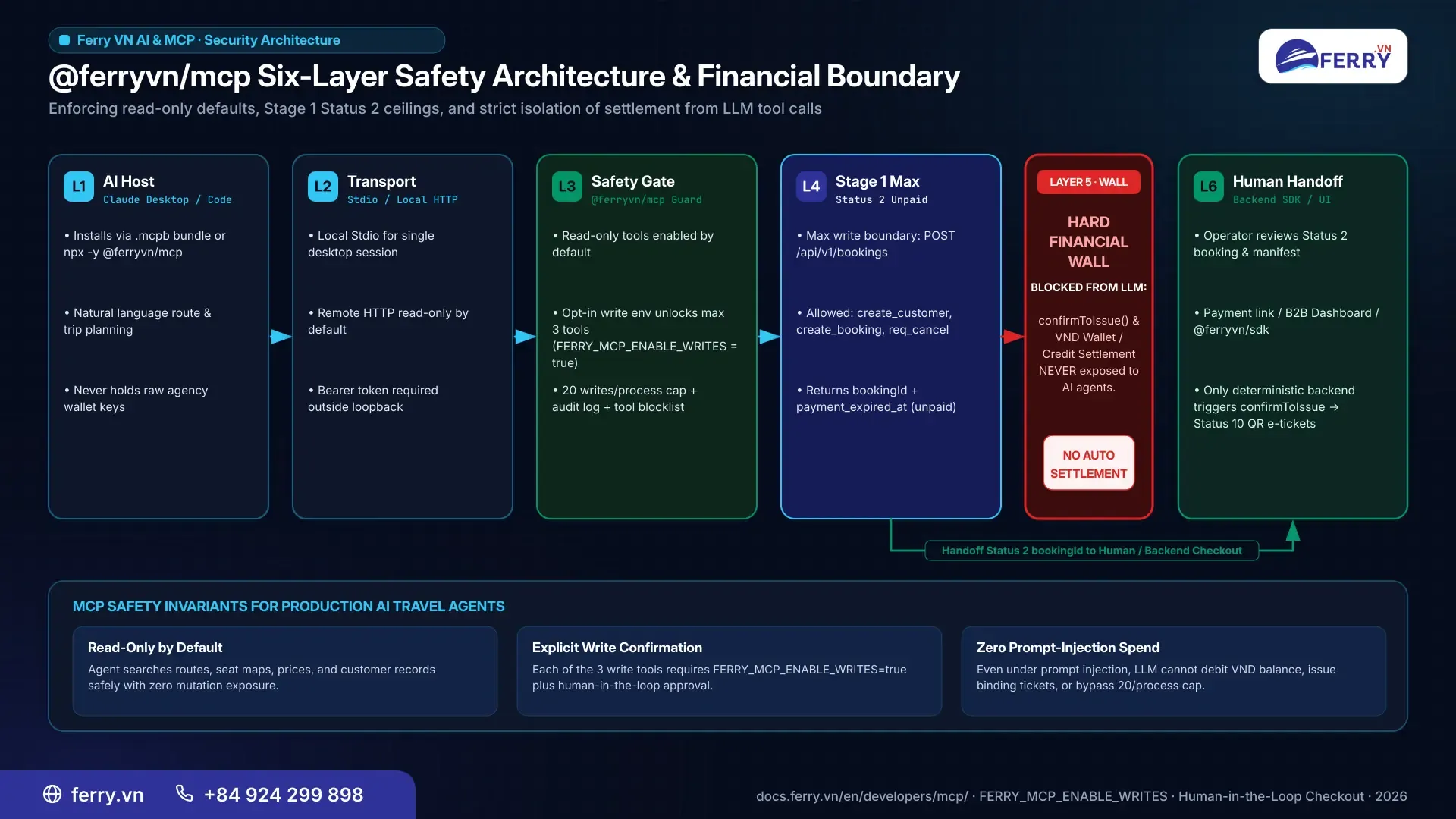
Through @ferryvn/mcp — built on the open Model Context Protocol — AI travel assistants search live piers, schedules, and fares read-only by default without ever accessing confirmToIssue or wallet debits, keeping financial settlement strictly inside partner backends. Review architecture patterns in our Ferry MCP server guide, unified Vietnam Ferry API spec, and Vietnam ferry distribution.
Partnering With Regional Maritime Infrastructure Leaders
Global platforms launch verified Vietnamese coastal and Mekong legs via Managed Merchant Listing (speed-to-market) or VND Net-Rate API Supply (full multimodal checkout and FX control). Explore corporate background on Ferry VN's About page, compare tiers on Ferry VN Pricing, or inspect live schemas in Ferry VN's intermodal integration docs (hi@ferry.vn · +84 924 299 898).
FAQ
Frequently Asked Questions
Why is the Southeast Asia ferry market harder to digitize than flights or European ferries?
Aviation relies on global GDS standards and European short-sea ferries adopted FerryGateway and LIKNOSS. Across Southeast Asia, dozens of independent private fleets per country run incompatible proprietary systems, settle in local currencies, follow distinct national manifest and tax laws, and face sudden monsoon sail bans.
What causes multimodal flight-plus-ferry or bus-plus-ferry itineraries to break in Southeast Asia?
Intermodal trips break at four seams: unrealistic transfer buffers before 30-to-45 minute port check-in cut-offs, asynchronous carrier ticketing without upstream hard seat holds, missing statutory passport manifest fields, and uncoordinated Beaufort Force 6 weather cancellations stranding downstream legs.
How does a federated regional aggregator model work for global OTAs?
Instead of building dozens of fragile domestic adapters per country, global OTAs integrate one country-level maritime distribution layer per market — such as Ferry VN in Vietnam — which normalizes local carriers, local bank settlement, statutory manifests, and bilingual port disruption ops behind one REST API.
What role does Model Context Protocol (MCP) play in intermodal ferry travel?
MCP servers like @ferryvn/mcp let AI travel assistants query real-time piers, schedules, seat availability, and fares conversationally to assemble multimodal itineraries. Because @ferryvn/mcp is read-only by default and never exposes issuance or payments, financial transactions stay strictly within partner backends.
How can global travel platforms add verified Vietnam ferry inventory into intermodal search?
Travel platforms connect to 15+ Vietnamese ferry operators under one Ferry VN contract via Managed Merchant Listing or VND Net-Rate API Supply (86 authenticated /api/v1/ routes and @ferryvn/sdk), validating full integration flows at zero cost on the uatexpress UAT environment.
- Ferry VN B2B Platform (MST 1801802790)
- Đăng ký đại lý vé tàu 15+ hãng
- Demo B2B Dashboard & FOM
- Tài liệu tích hợp API · SDK · MCP
- Hotline B2B 24/24: 0924 299 898 · hi@ferry.vn
- Zalo OA đối tác: Ferry VN Official

Related articles

SEA Ferry Yield & FOM Guide
Ferry booking software and yield management for Southeast Asian operators: HOSE:SKG fuel-margin proof, 5 load-factor levers, and FOM architecture benchmarks.

Vietnam Ferry Market 2026
Vietnam tourism statistics 2026 for island ferry markets: Phu Quoc 8.57M, Con Dao 612K, SKG Q3 fuel squeeze, VIMAWA Decree 33, and B2B distribution data.

APEC 2027 & Vietnam Ferry Fleets
Phu Quoc tourism statistics hit 8.57M in 9M 2026 (+60.2% international YoY) ahead of APEC 2027: institutional directory of Vietnam's 15+ ferry and Ro-Ro fleets.