







Build vs Buy Ferry Booking API
 Le Quoc KhoiCEO, Ferry VN JSC

Key Takeaways: Evaluating a ferry booking software build vs buy decision on Ferry VN Platform for Vietnam's island network requires pricing 36 months of multi-carrier adapter maintenance, VND treasury ops, and monsoon disruption support rather than only the initial sprint.
- Direct Build Multiplies Maintenance: Contracting 12+ Vietnamese operators bilaterally means separate legal agreements, incompatible seat/session adapters, and fragmented VND deposits across carriers.
- Unified API Compresses Launch to Weeks: Integrating Ferry VN JSC exposes 15+ operators (12 real Production adapters: 8 ticketing + 4 schedule lookup) under one B2B contract, one REST/SDK spec, and one VND wallet.
- Year 1 Build Is Under 40% of 3-Year Cost: Carrier portal changes, fleet exits or maintenance suspensions (Mai Linh Express, Lightning 68, Phu Quoc Express Vung Tau–Con Dao, Phu Quy Express), VIMAWA updates, and Force 6 closures dominate Years 2 and 3.
- Clear Break-Even Rule: Build direct only when one carrier drives >80% of volume and you already staff a Vietnamese entity with bilingual port ops. Otherwise, integrate Ferry VN's API or launch via Merchant Listing.
Every travel-tech CTO and Head of Supply entering Southeast Asia faces the same ferry booking software build vs buy fork: dedicate engineering sprints to direct carrier connectors, or integrate a regional aggregation layer under one commercial contract.
On a whiteboard, building direct looks cheap because teams price only the first happy-path adapter. In production, Vietnam's maritime market punishes naive estimates with undocumented session drops, Vietnamese-only port desks, fragmented VND deposits, and monsoon cancellations. This 36-month Total Cost of Ownership (TCO) analysis compares all three paths so leadership allocates capital efficiently.
Three Architectural Paths to Vietnam Ferry Supply
Online Travel Agencies (OTAs) and regional super-apps choose among three sourcing architectures, benchmarked across eight operational criteria below:
| Decision Criterion | Option A: Build Direct Carrier Adapters | Option B: Unified API (VND Net-Rate Supply) | Option C: Managed Merchant Listing |
|---|---|---|---|
| Commercial Contracting | 10 to 15+ separate Vietnamese carrier contracts | 1 B2B partner contract with Ferry VN JSC | 1 channel listing agreement (Trip.com, GetYourGuide, Viator) |
| Time to Multi-Island Launch | 6 to 14 months (legal, banking, per-carrier dev) | 2 to 6 weeks using @ferryvn/sdk and UAT |
1 to 3 weeks (zero backend ticketing code) |
| Engineering Maintenance | High (continuous per-operator adapter breakage) | Low (single /api/v1/ contract and typed SDK) |
Minimal (standard OTA storefront operations) |
| VND Treasury & Settlement | Separate VND pre-funded deposits per carrier | Single pre-funded VND partner wallet (plus approved credit line where applicable) | Periodic commercial settlement per OTA channel contract |
| Port & Monsoon Ops | Must staff Vietnamese-speaking port escalation desk | Backed by Ferry VN 24/7 local operations and /api/v1/disruptions |
Managed end-to-end by Ferry VN storefront ops |
| Retail Pricing & UX Control | 100% control over checkout, FX, and markup | 100% control over checkout, FX, and retail markup | Ferry VN manages catalog listings and published retail fares |
| Regulatory & Fleet Updates | Internal team tracks VIMAWA, Decree 70, fleet shifts | Normalized at platform layer (Resolution 202, VIMAWA, fleet status) | Handled directly on managed listings |
| Best Organizational Fit | Local Vietnamese single-carrier specialist | Ground-transport OTAs, intermodal search engines, super-apps | Global experience OTAs validating Vietnam demand fast |
For exact endpoint catalogs and November 2026 corridor coverage behind Option B, review the Unified Vietnam Ferry API specification.
Hidden Costs Inside a Direct Multi-Operator Build
Most in-house build budgets miss 2x to 4x of real 36-month cost by omitting local contracting friction, carrier instability, and non-engineering port operations.
Heterogeneous Adapter Engineering and Ongoing Breakage
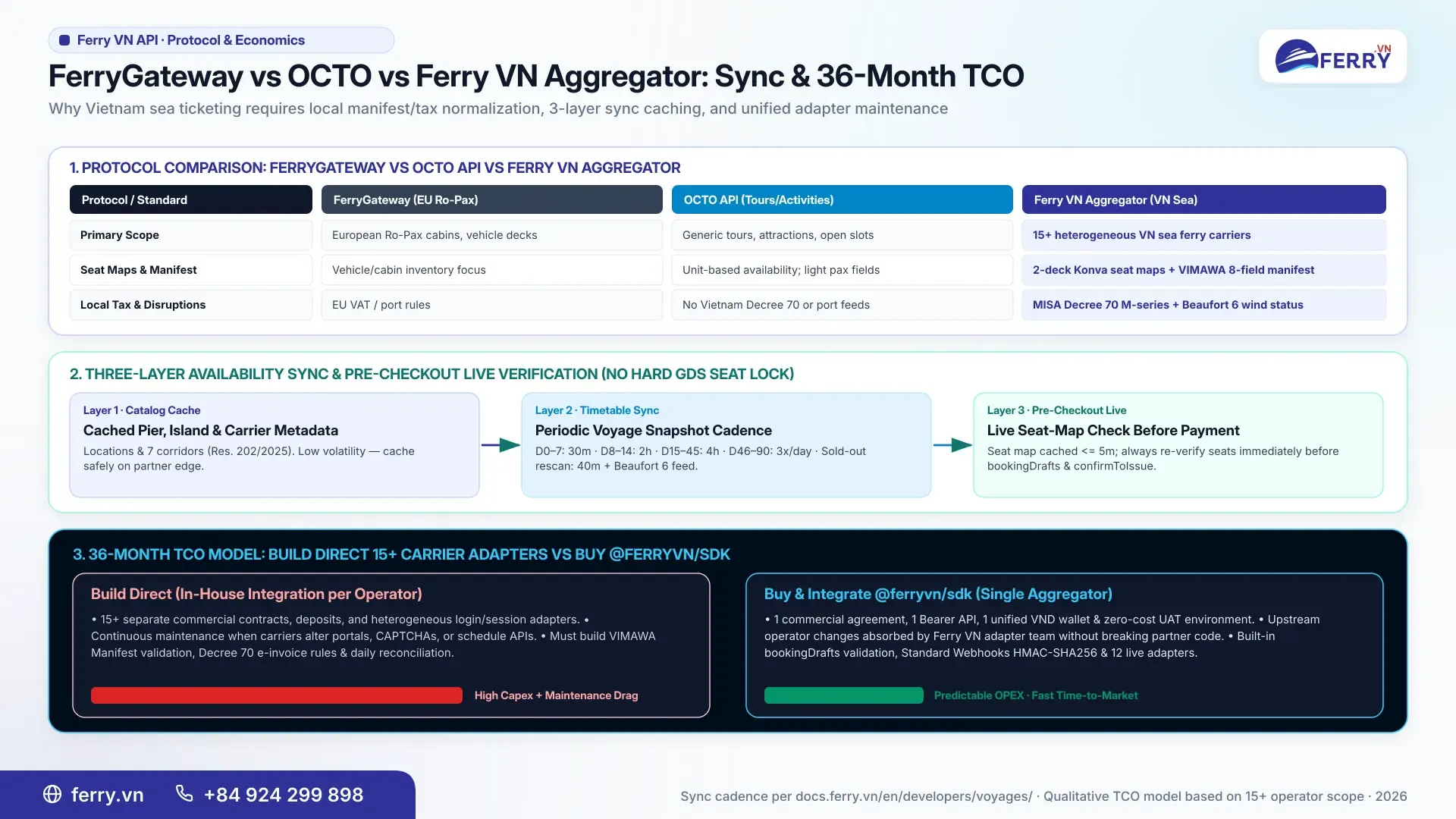
Unlike European Ro-Pax fleets unified on FerryGateway, Vietnam's 15+ island operators run incompatible reservation engines spanning JSON APIs, legacy web portals, semi-automated port desks (such as Sa Ky Port for Ly Son), and Ro-Ro ferries without automated ticketing.
Building in-house creates permanent engineering drag:
- Asymmetric latency and partial round-trips: Issuance completes in seconds on fast operators yet takes 5 to 8 minutes on slower links, requiring 600-second execution locks, polling workers, and partial leg refunds when outbound succeeds and return fails.
- Continuous fleet and route churn: Verified 2025–2026 disruptions break static carrier tables repeatedly — Mai Linh Express closed Can Tho–Con Dao in May 2025, Lightning 68 exited Rach Gia–Phu Quoc on July 28, 2026, Phu Quoc Express paused Vung Tau–Con Dao for maintenance from August 1, 2026 (expected January 2027), and Phu Quy Express paused HCMC–Con Dao from September 1, 2026 (expected January 2027).
- Unannounced portal mutations: Local engines rotate tokens or change seat-map schemas without versioned deprecation windows, pulling senior engineers off product work.
VND Treasury Fragmentation, Compliance, and Monsoon Ops
Direct contracting across Phu Quoc, Con Dao, Phu Quy, Ly Son, Nam Du, Hon Son, and HCMC–Vung Tau triggers ongoing finance and regulatory overhead under rules published on the Vietnam Government Portal:
- Fragmented working capital: Domestic carriers settle via prepaid VND transfers, locking cash across 10+ operator balances and manual Vietnamese spreadsheets.
- VIMAWA manifest compliance: Decree 33/2025/ND-CP and Circulars 16/2013 and 10/2024 require full name, birth date, passport/ID, and nationality for every traveler prior to departure clearance.
- Decree 70/2025/ND-CP e-invoices: Effective June 1, 2025, direct transport requires cash-register type M invoices with adjustment/replacement flows replacing direct cancellation.
- Beaufort Force 6 monsoon crises: September–February wind bans cancel hundreds of tickets on short notice, demanding 24/7 bilingual port support.
36-Month Total Cost of Ownership (TCO) Model
Comparing person-months and operational headcount gives CFOs and CTOs a portable TCO benchmark across any engineering location, structured on the Ferry VN API and SDK platform.
| Cost Category (36-Month Horizon) | Build Direct (10–12 VN Operators) | Buy Unified API (Ferry VN REST / SDK) | Structural TCO Driver |
|---|---|---|---|
| Phase 1: Legal, Contracting & Banking | 4–9 months BD + local entity setup across 10+ carriers | 2–4 weeks (1 B2B contract + 1 VND wallet) | Eliminates per-carrier Vietnamese negotiation |
| Phase 2: Initial Engineering & QA | 14–24 senior eng person-months (adapters, reconciliation) | 1.5–3 senior eng person-months (@ferryvn/sdk + uatexpress) |
85%+ reduction in initial build effort |
| Years 1–3: Adapter Maintenance | 0.75–1.5 FTE continuously (27–54 person-months over 3 yrs) | 0.1–0.2 FTE (~4–7 person-months for SDK/webhook upkeep) | Carrier portal shifts absorbed centrally by Ferry VN |
| Finance & Reconciliation | 10+ carrier VND accounts, manual statement matching | 1 VND wallet + Transactions / Debt Ledgers API |
Concentrates working capital and automates matching |
| Port & Weather Escalation Ops | Dedicated bilingual ops staff (Sep–Feb monsoon peaks) | Shared escalation via Ferry VN local desk + /disruptions |
Avoids hiring dedicated Vietnam maritime ops |
| Time to Market | Misses 1–2 dry-season / APEC 2027 ramp windows | Live in weeks ahead of Phu Quoc & Con Dao demand | Captures inbound revenue immediately |
Review concrete sizing and retry patterns for the 1.5-to-3-person-month integration path in our Ferry VN SDK quickstart and API reliability patterns.
When to Build Direct vs When to Integrate Ferry VN
Build direct connectors only if all three rules apply: one carrier exceeds 80% of projected 36-month volume, you already staff a Vietnamese entity with local VND banking and bilingual port ops, and you require bespoke full-vessel charter software outside standard API scopes.
Integrate Ferry VN JSC (Tax ID 1801802790, serving 150+ agencies, 13,000+ users, and six live OTAs — Trip.com, GetYourGuide, 12Go, Klook, Viator, Tatinta — across 15+ operators as of November 2026) when you want multi-island scale under one contract via B2B API partnership onboarding. Choose Managed Merchant Listing for speed or VND Net-Rate API Supply for full UX and FX control as detailed in our Vietnam B2B ferry distribution guide and net rate versus commissionable rate breakdown.
Stay realistic about remaining engineering work: your backend still handles retail FX, pre-checkout layout refreshes (no upstream hard seat holds), bookings.list timeout recovery (no POST /bookings idempotency keys), opt-in HMAC-SHA256 webhooks, and daily reconciliation — or opt for zero checkout code via a white-label ferry booking portal.
Executing a Low-Risk Technical Evaluation
Run a 5-day engineering spike rather than debating TCO spreadsheets: request zero-cost uatexpress UAT keys on https://api.ferryvn.net, wire @ferryvn/sdk search through PDF download and signed webhook verification in 2–3 days, and measure real developer hours against a direct multi-carrier roadmap. Browse Ferry VN's Scalar OpenAPI explorer and technical integration docs, or contact hi@ferry.vn (+84 924 299 898).
FAQ
Frequently Asked Questions
How long does it take to integrate Ferry VN compared to building direct Vietnamese carrier adapters?
A backend team using @ferryvn/sdk and zero-cost uatexpress UAT typically completes a full search, checkout, issuance, webhook, and reconciliation integration in 2 to 6 weeks. Contracting and building direct adapters across 10 to 12 local Vietnamese operators typically requires 6 to 14 months plus ongoing maintenance.
Do international OTAs need a Vietnamese legal entity to sell ferries via Ferry VN?
No. Global OTAs and regional platforms partner under one commercial contract with Ferry VN JSC (Tax ID 1801802790), choosing either managed Merchant Listing or VND Net-Rate API Supply without incorporating locally or opening separate deposit accounts with 15+ domestic carriers.
Can our engineering team run a zero-cost technical proof of concept before commercial launch?
Yes. Ferry VN operates a dedicated UAT environment (https://api.ferryvn.net) restricted to the simulated uatexpress carrier via OPERATOR_ADAPTER_ALLOWLIST=uatexpress. Teams can test search, seat layouts, VIMAWA manifests, PDF boarding passes, webhooks, and cancellations at zero real cost.
What ongoing engineering maintenance remains after integrating a unified ferry aggregator API?
Partner teams maintain their own checkout UX, retail FX markup rules, API key and whsec_... webhook secret rotations, daily booking status reconciliation jobs, and filtering for schedule-lookup-only carriers. Ferry VN absorbs individual carrier portal changes, session management, and route/fleet adapter updates centrally.
When should a travel tech company choose a white-label portal instead of building a custom REST API checkout?
Choose a white-label booking portal when you need branded multi-operator Vietnam ferry sales live within days without allocating frontend or backend engineering sprints. Choose the REST API and @ferryvn/sdk when you need full control over multimodal bundling, native mobile UX, and custom retail FX pricing.
- Ferry VN B2B Platform (MST 1801802790)
- Đăng ký đại lý vé tàu 15+ hãng
- Demo B2B Dashboard & FOM
- Tài liệu tích hợp API · SDK · MCP
- Hotline B2B 24/24: 0924 299 898 · hi@ferry.vn
- Zalo OA đối tác: Ferry VN Official

Related articles

Unified Vietnam Ferry API
Vietnam Ferry API connects 15+ operators via 86 REST routes, @ferryvn/sdk, CLI, and MCP server with zero-cost uatexpress UAT and opt-in HMAC-SHA256 webhooks.

VIMAWA Manifest & QR Specs
E-ticket QR code and VIMAWA passenger manifest API specs in Vietnam: Circular 10/2024 fields, 120145 validation, boarding PDFs, and Decree 70/2025 invoices.

Live Availability for Ferries
Ferry availability sync API architecture for OTAs: 30m-4h sync tiers, 40m sold-out rescans, seat-map rechecks, and Force 6 monsoon disruption polling.

FerryGateway vs OCTO vs Aggregator
FerryGateway vs OCTO compared for Vietnam and SEA ferries: deck seat maps, VIMAWA manifests, Ro-Ro feeds, and Ferry VN's unified REST aggregator adapter.