







FerryGateway vs OCTO vs Aggregator
 Le Quoc KhoiCEO, Ferry VN JSC

Key Takeaways: Evaluating FerryGateway vs OCTO for Southeast Asian island ferries hinges on local supplier adoption rather than protocol elegance alone, because European maritime switches like FerryGateway and experience standards like OCTO leave domestic Vietnamese islands unbookable.
- FerryGateway Excels in European Ro-Pax: Designed by European ferry lines for cabins, vehicles, and multi-leg North Sea or Baltic crossings, but carries near-zero adoption among Southeast Asian high-speed catamaran operators.
- OCTO Excels in Tours, Breaks on Port Compliance: Built for attraction vouchers across GetYourGuide, Viator, and Bokun, yet lacks native deck seat maps, mandatory per-passenger maritime manifests, and monsoon trip-cancellation state machines.
- Regional Maritime Aggregators Close the Last Mile: Ferry VN JSC normalizes 15+ Vietnamese operators (12 live Production adapters: 8 ticketing + 4 schedule lookup) behind one REST API,
@ferryvn/sdk, and opt-in Standard Webhooks HMAC-SHA256.- Adapter Pattern Bridges Both Worlds: OCTO-native and multimodal Online Travel Agencies (OTAs) map cleanly onto Ferry VN's
/api/v1/contract without rewriting core storefront schemas.
Evaluating FerryGateway vs OCTO for Southeast Asian sea routes forces connectivity architects to confront a sharp gap between global travel standards and local maritime reality. Two open specifications dominate travel-tech discussions today: FerryGateway for European maritime carriers and OCTO for tours and activities.
Forcing Vietnam's island high-speed ferries through a tour-voucher schema or waiting for local coastal carriers to implement a European Ro-Pax switch delays regional expansion by years. This architectural comparison benchmarks FerryGateway, OCTO, and a regional maritime aggregator API side by side and provides a TypeScript adapter pattern for connecting global OTAs to Vietnam's island corridors.
Three Connectivity Models for Ferry Distribution
Every OTA or intermodal platform adding coastal passenger ferries chooses among three connectivity architectures: an open maritime switch (FerryGateway), an open tour-and-activity standard (OCTO), or a localized regional aggregator API (such as Ferry VN). Each model optimizes for a fundamentally different supply base and regulatory environment.
| Architectural Dimension | FerryGateway (Open Maritime Standard) | OCTO API (Tours & Activities Standard) | Regional Maritime Aggregator (Ferry VN) |
|---|---|---|---|
| Primary Region & Adoption | Northern & Western Europe (major Ro-Pax lines) | Global experiences, museums, day tours | Vietnam coastal & island corridors (15+ operators) |
| Core Domain Abstraction | Sailings, cabins, decks, vehicle lengths, freight | Products, options, timeslots, redemption vouchers | Piers, voyages, cabin seat maps, multi-leg bookings |
| Seat Maps & Cabin Tiers | Deep native cabin, berth, and deck allocation | Not native (requires custom extensions or general admission) | Native ECO/VIP boat layouts and vacant seat counts |
| Vehicle & Ro-Ro Support | Native car, camper, trailer, and cargo dimensions | Unsupported natively | Schedule and fare lookup on Ro-Ro adapters (ThanhThoi, BinhAnHaTien) |
| Mandatory Passenger Manifests | Supported for EU maritime directives | Typically lead-traveler focused unless heavily extended | Native per-passenger VIMAWA manifest enforcement (120145) |
| Disruption & Weather Handling | Operator-dependent schedule updates | Basic cancellation status | Dedicated /api/v1/disruptions feed + disruption.* webhooks + status 16 |
| Settlement & Currency | Direct bilateral carrier settlement (EUR/GBP/SEK) | Separate commercial billing per supplier | Single VND pre-funded partner wallet or managed Merchant Listing |
| Vietnam Island Supply Depth | Near-zero domestic coverage | Fragmented reseller activity listings | 12 live Production adapters (8 ticketing + 4 schedule lookup) |
For the complete list of Vietnamese island corridors, updated Resolution 202/2025/QH15 port boundaries, and fleet statuses live on Ferry VN, review our Vietnam Ferry API spec.
Deep Dive: FerryGateway vs OCTO Against Maritime Reality
Standards succeed only where suppliers adopt them. Understanding where FerryGateway and OCTO were engineered to win explains why neither specification solves domestic Southeast Asian sea transport on its own.
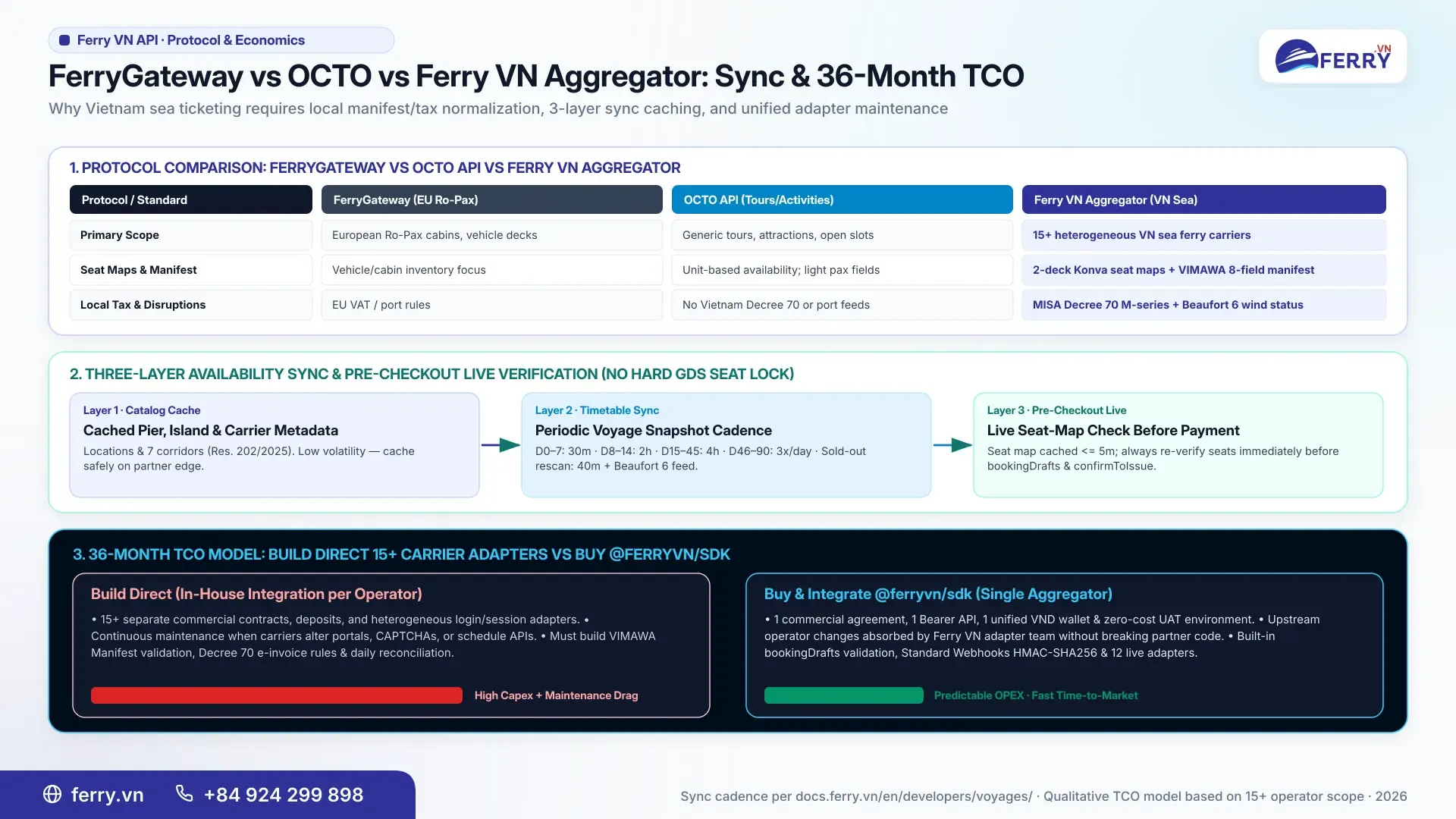
FerryGateway: Built for European Ro-Pax, Absent in SEA
Founded in 2014 to 2015 by major European ferry lines, FerryGateway provides an open maritime data standard and switch architecture covering multi-leg itineraries, cabin berths, meal packages, and exact vehicle dimensions. Across the English Channel, Irish Sea, and Baltic Sea, FerryGateway eliminates redundant bilateral XML/SOAP connectors across large asset-heavy European fleets.
Across Vietnam and Southeast Asia, however, supply looks completely different. High-speed island fleets run 150-to-600-seat monohulls and catamarans (plus larger coastal vessels) on 1-to-5-hour crossings using proprietary domestic engines, Vietnamese agency portals, or port-managed boards. No domestic Vietnamese carrier exposes FerryGateway endpoints, and European GDS platforms like LIKNOSS (>11 million annual European tickets) or Distribusion (covering Vietnam Railways) maintain zero direct Vietnamese domestic ferry adapters.
OCTO API: Fast for Experiences, Brittle for Scheduled Sea Transport
The OCTO API specification became the de facto standard across tour and activity platforms including GetYourGuide, Viator, and Bokun. Its clean REST primitives (Availability, Booking, Unit) onboard thousands of museum tickets and day cruises rapidly.
Applied to scheduled Vietnamese high-speed ferries, OCTO hits four structural friction points:
- No native deck seat selection: High-speed vessels assign physical numbered seats across ECO and VIP decks. OCTO's capacity-count model cannot render interactive cabin layouts or resolve
UnavailableSeats(150201) collisions when another channel claims seatA12during checkout. - Lead-traveler checkout friction: Under Vietnam Maritime and Waterway Administration (VIMAWA) Circular 16/2013/TT-BGTVT and Circular 10/2024/TT-BGTVT, every traveler (including infants and children) requires full name, date or year of birth, passport or ID number, and nationality before port clearance. Retrofitting per-passenger manifests into generic OCTO
questionsinvites missing-field rejections. - Asymmetric confirmation latency: OCTO assumes near-instant synchronous confirmation (
POST /bookings/{uuid}/confirm). On live Vietnamese ferry links, automated issuance ranges from seconds up to 5 to 8 minutes depending on carrier infrastructure, requiring asynchronous polling and execution locks (600s). - Monsoon mass cancellations: Beaufort Force 6 wind bans suspend entire corridors simultaneously across Con Dao, Phu Quy, and Ly Son, requiring structured disruption feeds (
delayedvscancelled), booking status16(Trip Cancelled), and multi-leg partial refund reconciliation.
How a Regional Aggregator API Bridges Heterogeneous Local Carriers
Rather than waiting for 15+ independent Vietnamese operators to implement a European protocol, Ferry VN absorbs carrier fragmentation inside a normalized OperatorAdapter layer documented on the Ferry VN API and SDK platform overview. Ferry VN exposes 9 public catalog routes and 86 authenticated /api/v1/ partner routes paired with @ferryvn/sdk, @ferryvn/cli, and @ferryvn/mcp.
An OTA whose core stack speaks OCTO or a proprietary intermodal schema can integrate Vietnam ferries by wrapping @ferryvn/sdk in one thin adapter that explicitly isolates the 4 schedule-lookup-only Production carriers (BinhAnHaTien, ThanhThoi, HangChauTourist, SaiGonWaterGo):
import { FerryClient, isVoyageBookable } from '@ferryvn/sdk'

const SCHEDULE_ONLY_OPERATORS = new Set([
  'BinhAnHaTien',
  'ThanhThoi',
  'HangChauTourist',
  'SaiGonWaterGo'
])

export interface NormalizedSailing {
  sailingId: string
  operatorCode: string
  departureUtc: string
  bookableViaApi: boolean
  currency: 'VND'
  baseFareVnd: number
}

export class FerryVnConnectivityAdapter {
  constructor(private readonly ferry: FerryClient) {}

  async searchNormalizedSailings(
    fromName: string,
    toName: string,
    vietnamDateYmd: string
  ): Promise<NormalizedSailing[]> {
    const [from] = await this.ferry.locations.find(fromName)
    const [to] = await this.ferry.locations.find(toName)
    if (!from || !to) return []

    const results: NormalizedSailing[] = []
    for await (const item of this.ferry.voyages.iterate({
      date: vietnamDateYmd,
      departureId: from.id,
      destinationId: to.id,
      limit: 50
    })) {
      if (!isVoyageBookable(item)) continue
      const opCode = item.voyage.operatorCode ?? ''
      results.push({
        sailingId: item.voyage.id,
        operatorCode: opCode,
        departureUtc: item.voyage.departureTime,
        bookableViaApi: !SCHEDULE_ONLY_OPERATORS.has(opCode),
        currency: 'VND',
        baseFareVnd: item.minPriceVnd ?? 0
      })
    }
    return results
  }
}
Inside this adapter boundary, your backend enforces Ferry VN's exact write-safety invariants: re-fetching boat layouts right before bookingDrafts.create(), never retrying timed-out POST /api/v1/bookings without checking bookings.list, verifying opt-in Standard Webhooks HMAC-SHA256 on raw UTF-8 bytes, and polling GET /api/v1/bookings/{id} to terminal state 10 or 6.
For runnable checkout payloads and mandatory passenger manifest schemas, follow our Ferry VN SDK quickstart and Vietnam passenger manifest and QR e-ticket guide.
Decision Framework: Matching Connectivity Protocol to OTA Footprint
Global connectivity teams rarely rely on one protocol worldwide. The optimal architecture combines global standards where suppliers adopt them with localized aggregation layers where maritime supply stays fragmented, explored commercially through Ferry VN's B2B API partner portal.
| OTA or Platform Archetype | Primary Global Standard | Recommended Vietnam Ferry Strategy | Why It Wins |
|---|---|---|---|
| European Ro-Pax Ferry OTA | FerryGateway / LIKNOSS | Integrate Ferry VN REST API as APAC maritime adapter | Connects 15+ Vietnamese carriers without waiting on EU switch adoption |
| Global Tour & Activity Marketplace | OCTO API (GetYourGuide, Viator, Klook) | Launch via Merchant Listing first, or map OCTO checkout fields to Ferry VN API | Preserves mandatory VIMAWA manifests and real boarding pass PDFs |
| Intermodal Ground-Transport OTA | Proprietary multimodal switch (12Go, Trip.com, Omio-class) | VND Net-Rate API Supply via @ferryvn/sdk or /api/v1/ REST |
Full control over retail FX markup, search UX, and combined legs |
| Regional SEA Super-App or DMC | Direct REST API or White-Label Portal | @ferryvn/sdk API for custom apps, or multi-tenant white-label portal |
Rapid multi-island launch with single VND wallet and zero carrier contracting |
Compare global GDS supply gaps in our global ferry GDS and Vietnam supply gap audit, vetting criteria in our OTA connectivity partner and channel manager guide, and wholesale structures in our Vietnam B2B ferry distribution guide.
Next Steps: Testing the Unified Vietnam Ferry Spec on UAT
Connectivity architects can benchmark Ferry VN's exact OpenAPI contract before signing bilateral carrier agreements. Ferry VN hosts an isolated UAT environment at https://api.ferryvn.net (https://api.ferryvn.net/docs) locked via OPERATOR_ADAPTER_ALLOWLIST=uatexpress, letting teams test search, seat maps, VIMAWA validation, boarding PDFs, and cancellations at zero real cost.
Keep expectations candid from day one: Ferry VN's Public Partner API has no upstream hard seat holds or idempotency keys on booking creation, and Standard Webhooks HMAC-SHA256 signing (3 automatic retries) is opt-in per organization inside the Dashboard. Inspect endpoint schemas in the Scalar REST API reference and implementation guides in Ferry VN's adapter and SDK docs, or contact hi@ferry.vn (+84 924 299 898).
FAQ
Frequently Asked Questions
Do Vietnamese high-speed ferry operators support the FerryGateway standard?
No. FerryGateway is adopted primarily by European Ro-Pax carriers handling overnight cabins and vehicle decks. Vietnam's 15+ coastal high-speed operators run heterogeneous domestic reservation engines, requiring a regional aggregator API like Ferry VN to normalize schedules, seat maps, and issuance.
Can an OCTO-native tour OTA sell Vietnam island ferries without rebuilding its core checkout?
Yes, through two paths. OTAs can launch immediately via Ferry VN's managed Merchant Listing model (already live on GetYourGuide, Viator, and Trip.com), or map custom per-passenger manifest fields inside their checkout onto a thin adapter wrapping Ferry VN's REST API.
How does a regional ferry aggregator handle operators that do not support automated API ticketing?
On Production, Ferry VN connects 12 real operator adapters: 8 support API ticket issuance (7 automated plus semi-automated CangSaKy), while 4 (BinhAnHaTien, ThanhThoi, HangChauTourist, SaiGonWaterGo) support schedule and fare lookup only. Adapters should filter or clearly label lookup-only carriers.
What is the difference between a global ferry GDS like LIKNOSS or Distribusion and Ferry VN?
LIKNOSS (>11 million tickets/year) focuses on European ferry fleets, and Distribusion focuses on global bus and rail (including Vietnam Railways) without domestic Vietnamese ferry adapters. Ferry VN operates as the specialized Vietnam maritime layer connecting 15+ local coastal and island operators.
Can engineering teams evaluate Ferry VN's API schema without signing individual carrier contracts?
Yes. Architects can inspect all 9 public and 86 partner endpoints on https://api.ferry.vn/docs and run zero-cost end-to-end integration tests against the simulated uatexpress operator on UAT (https://api.ferryvn.net) under a single Ferry VN partner onboarding workflow.
- Ferry VN B2B Platform (MST 1801802790)
- Đăng ký đại lý vé tàu 15+ hãng
- Demo B2B Dashboard & FOM
- Tài liệu tích hợp API · SDK · MCP
- Hotline B2B 24/24: 0924 299 898 · hi@ferry.vn
- Zalo OA đối tác: Ferry VN Official

Related articles

Unified Vietnam Ferry API
Vietnam Ferry API connects 15+ operators via 86 REST routes, @ferryvn/sdk, CLI, and MCP server with zero-cost uatexpress UAT and opt-in HMAC-SHA256 webhooks.

VIMAWA Manifest & QR Specs
E-ticket QR code and VIMAWA passenger manifest API specs in Vietnam: Circular 10/2024 fields, 120145 validation, boarding PDFs, and Decree 70/2025 invoices.

Live Availability for Ferries
Ferry availability sync API architecture for OTAs: 30m-4h sync tiers, 40m sold-out rescans, seat-map rechecks, and Force 6 monsoon disruption polling.